Scaling Success with Custom Enterprise Software
How purpose-built enterprise software helps organizations connect systems, automate workflows, modernize operations and create a scalable foundation for growth.
HyperCode
Technology Consulting

A practical guide to choosing an enterprise AI platform that can scale with your business across data, security, integration, governance, flexibility, performance, and cost.
Enterprise AI has changed dramatically over the last few years. For many companies, the conversation is no longer about whether artificial intelligence has a place in the business. The more difficult question is how to use it effectively at scale.
A small AI pilot can be relatively straightforward. A team might introduce an AI assistant, automate a repetitive task, or experiment with generative AI for internal use. If the pilot works, however, the next stage becomes much more complicated.
What happens when 50 users become 5,000? What happens when AI needs access to customer information, internal databases, cloud applications, or business-critical workflows? How do you control access, monitor performance, manage costs, and protect sensitive information?
These are the questions that make choosing the right enterprise AI platform so important. The best platform isn’t necessarily the one with the most features or the newest AI model. It’s the one that fits your business today while giving you enough flexibility to grow tomorrow.
The platform at a glance
Everything an enterprise AI platform has to connect
Enterprise AI Platform
One of the easiest mistakes to make with AI is starting with the technology. A company sees an impressive AI platform and immediately starts looking for places to use it. A better approach is the opposite: identify a meaningful business problem first and then determine what technology is needed to solve it.
Maybe your customer service team spends hours answering the same questions. Perhaps employees have difficulty finding information scattered across thousands of documents. Your operations team may still be moving information manually between systems. Those are tangible problems.
Before selecting a platform, ask: What are we trying to improve? How will we measure success? And what would make this investment worthwhile? Those three questions can prevent a lot of expensive experimentation.
An AI solution that works well during a demonstration may behave very differently in production. Imagine an internal AI assistant initially being tested by 20 employees. The results are encouraging, so the company decides to make it available to 2,000 employees.
Suddenly, the organization has to think about authentication, permissions, data access, infrastructure capacity, response times, monitoring, usage costs, security, and support. This is where scalability matters.
Illustrative example
From AI pilot to enterprise scale
20 users
Pilot
200 users
Department
2,000 users
Enterprise
5,000+ users
Scaled AI
What growth introduces
A scalable enterprise AI platform should be capable of growing with the organization without requiring the entire system to be redesigned every time usage increases.
AI gets most of the attention, but enterprise AI projects often succeed or fail because of data. Businesses typically have information distributed across multiple systems: CRM platforms, ERP systems, databases, spreadsheets, cloud storage, documents, APIs, and legacy applications.
For AI to become genuinely useful, it often needs controlled access to some of that information. That means integration should be a major part of your platform evaluation.
Ask whether the platform can work with your existing technology environment and whether your organization can control exactly what information AI applications are permitted to access. If connecting AI to your existing systems requires complicated workarounds every time, scaling the platform will become increasingly difficult.
Reference architecture
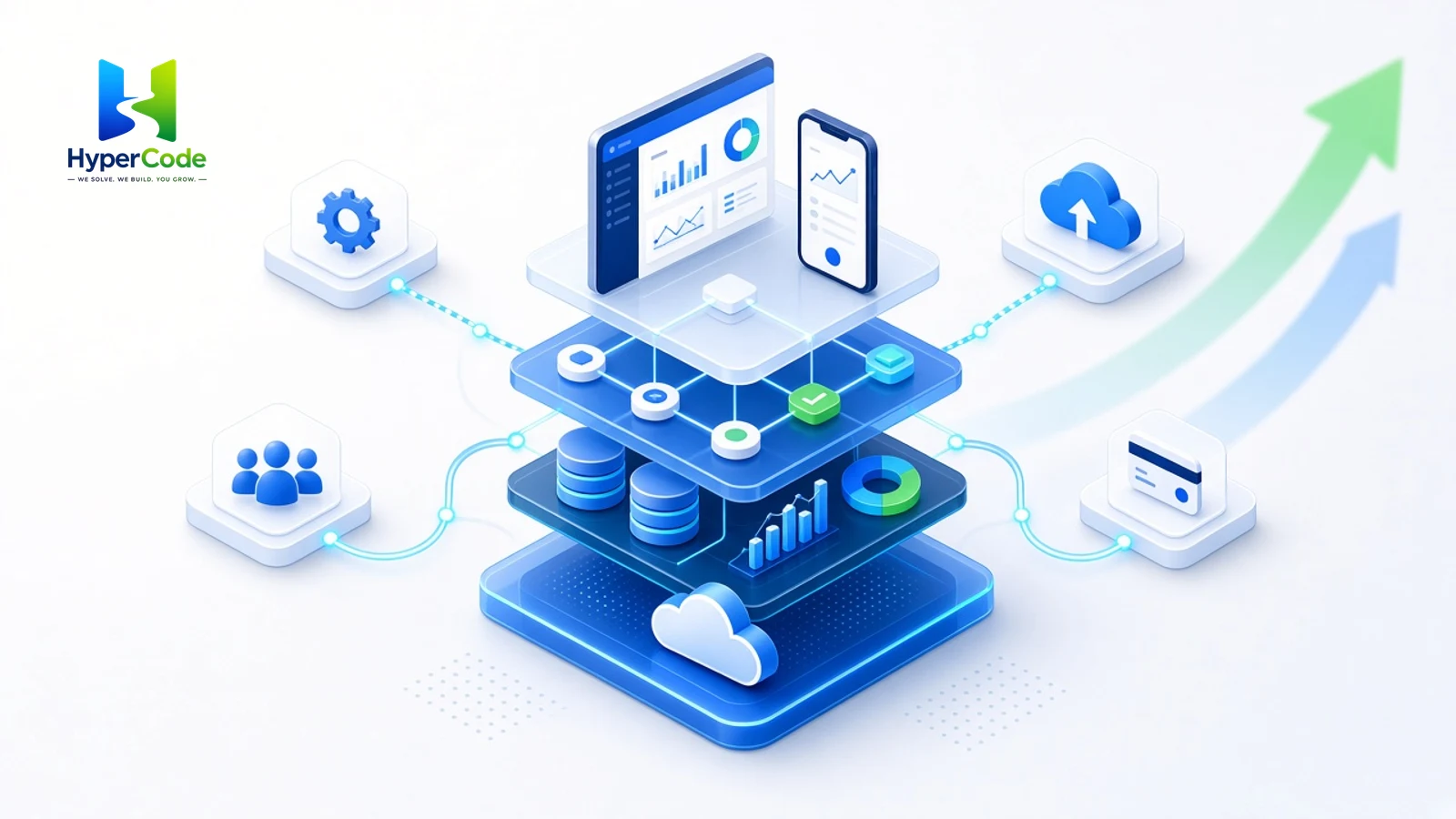
How a scalable enterprise AI platform fits together
Business experience
AI & orchestration
Enterprise integration
Platform
Across all layers
GovernanceSecurityObservabilityThe more useful an AI system becomes, the more likely it is to interact with valuable business information. That’s why security should be part of the architecture from the beginning.
Organizations should understand how users are authenticated, how permissions are managed, how data is encrypted, what information is logged, and whether sensitive data could unintentionally become available to unauthorized users.
The requirements will vary significantly between businesses. A public marketing assistant and an internal AI application working with financial or healthcare information clearly shouldn’t have identical security controls. The important point is to evaluate security according to the actual use case rather than treating it as a generic platform feature.
AI technology is moving quickly. A model that is the best option for your organization today may not be the best option two years from now—or even six months from now.
Different models may also be better suited to different jobs. One might provide excellent reasoning capabilities, while another may offer lower costs or faster responses for high-volume tasks.
Model flexibility
Don’t build the business around one model
Architecture should allow technology choices to evolve.
For that reason, businesses should think carefully before building an entire AI strategy around one model or provider. Where practical, the architecture should provide enough flexibility to evaluate and adopt different technologies as requirements change.
When five employees are experimenting with AI, informal oversight might seem manageable. When hundreds of employees and multiple business applications are using AI, it isn’t.
Organizations need to know where AI is being used, what data those systems can access, who is responsible for them, and whether they’re performing as expected.
Good AI governance doesn’t need to mean creating layers of bureaucracy. It means establishing sensible controls so the organization can innovate without losing visibility. That could include application inventories, access policies, evaluation processes, human review for sensitive decisions, usage monitoring, security reviews, and clear ownership.
AI platforms can appear inexpensive during early testing because usage is limited. Production environments are different. Costs can come from model/API consumption, cloud infrastructure, data processing, storage, integrations, monitoring, development, security, and ongoing maintenance.
Instead of asking only, “How much does this platform cost?”, ask: “What will this platform cost when our usage is ten times larger?” Then compare that number with the expected business value.
If an AI workflow costs $20,000 per year but eliminates $100,000 worth of repetitive manual work, the economics may be attractive. If an expensive AI implementation produces no measurable improvement, the technology itself doesn’t make it a successful investment.
Most organizations eventually face this decision. An off-the-shelf AI platform can help companies move quickly. It may already include infrastructure, security capabilities, integrations, monitoring tools, and prebuilt functionality. But standardized platforms don’t always fit specialized business processes.
Custom development provides greater flexibility. Businesses can design workflows, integrations, applications, and user experiences around their specific requirements. The trade-off is additional development and maintenance responsibility.
For many enterprises, the practical answer is somewhere in the middle. A hybrid approach can use established cloud and AI technologies for the underlying capabilities while developing custom applications, integrations, automation, and business logic around them.
Build, buy or hybrid
Three ways to put an enterprise AI platform in place
Buy
Move quickly with infrastructure, security capabilities, integrations, monitoring tools and prebuilt functionality already in place.
Trade-off: standardized platforms don’t always fit specialized business processes.
Build
Design workflows, integrations, applications and user experiences around your specific requirements.
Trade-off: additional development and maintenance responsibility.
Hybrid
Use established cloud and AI technologies underneath, with custom applications, integrations, automation and business logic built around them.
Keep in mind: the right balance depends on the business, its systems and its goals.
Choose the architecture that fits the business.
The goal isn’t to build everything yourself or buy everything from one vendor. The goal is to create the right architecture for the business.
Before committing to a platform, it helps to walk through a short set of questions with both business and technology stakeholders in the room.
Evaluation checklist
Nine questions to ask before you choose
Will this architecture still work if usage grows substantially?
Can it work with the systems and data we already have?
Can we properly control access to sensitive information?
Can we understand and monitor how AI is being used?
Can the architecture adapt as AI technology changes?
Will users receive reliable results at an acceptable speed?
Do we understand what production-scale usage will actually cost?
Can we measure whether AI is improving something meaningful?
Who will maintain, monitor, secure, and improve the solution after launch?
At HyperCode, we believe successful enterprise AI starts with understanding the business—not simply choosing a model. That means looking at the complete environment: existing applications, data, cloud infrastructure, workflows, security requirements, integration needs, and business objectives.
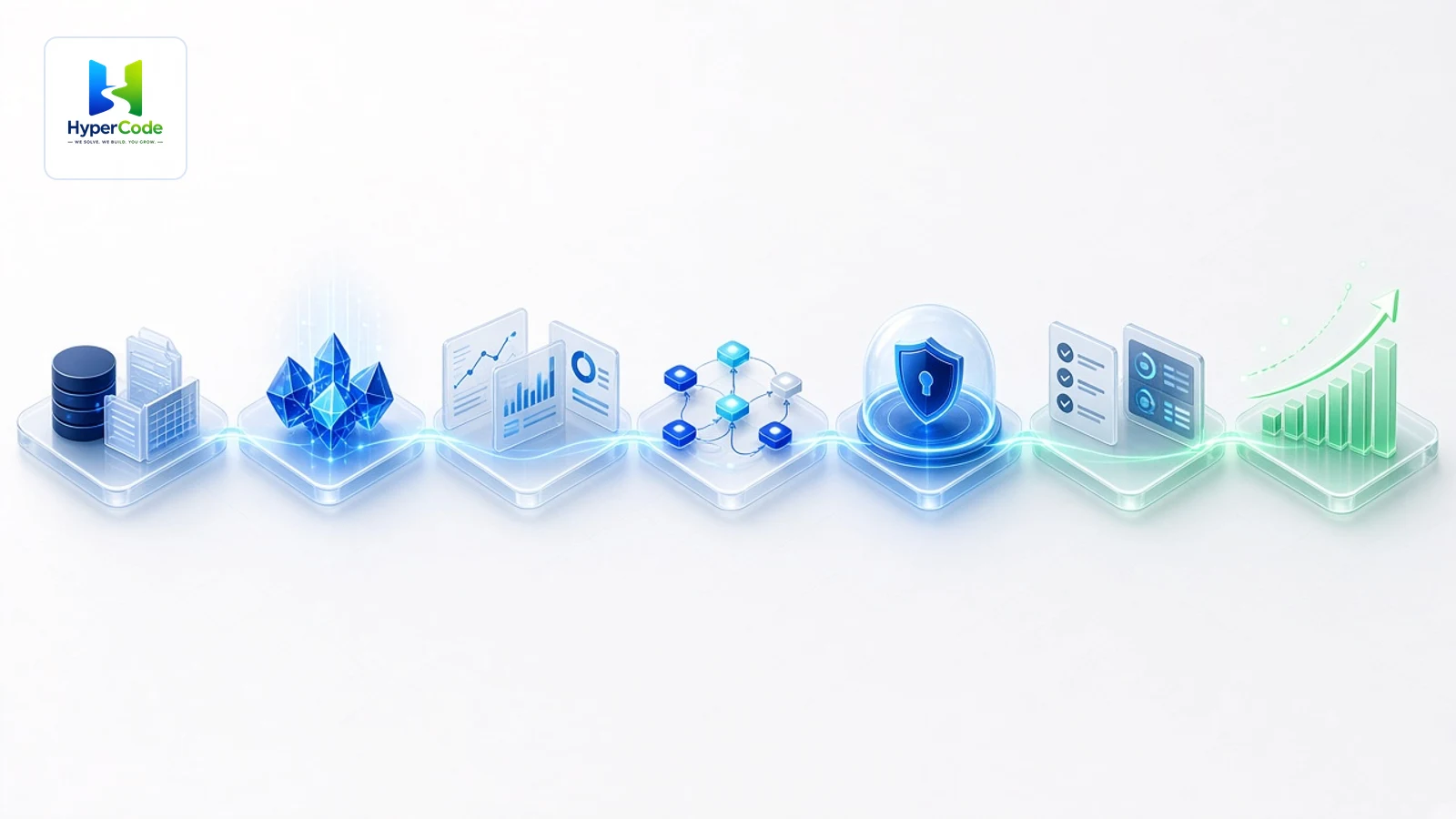
How HyperCode delivers
From strategy to optimization
This approach helps turn AI from an interesting technology experiment into something that can actually operate inside the business. Enterprise AI should make an organization more efficient, help people make better decisions, improve customer experiences, create new capabilities, or solve problems that were previously difficult to address.
Related HyperCode services include AI consulting, generative AI solutions, AI workflow automation, data engineering, API development and integration, and cloud migration.
Choosing an enterprise AI platform is an important technology decision, but it is also a business decision. Don’t choose a platform simply because AI is receiving attention. Don’t assume the largest provider is automatically the best fit. And don’t design your entire strategy around a short-term demonstration.
Start with a real business problem. Understand your data. Plan for security and governance. Think about what happens when usage grows. Measure the economics. And choose an architecture that gives your organization room to evolve.
The companies that get the most value from enterprise AI won’t necessarily be the companies that adopt the most AI tools. They’ll be the ones that connect AI to the right problems and build the foundation required to scale those solutions responsibly.
For a closer look at where generative AI creates value inside an organization, read How Enterprise Generative AI Drives Strategic Innovation.
An enterprise AI platform is a technology environment that enables organizations to develop, integrate, deploy, manage, and scale AI applications across business operations.
Key considerations include scalability, security, data integration, governance, model flexibility, performance, cost, compatibility with existing systems, and long-term support.
There isn’t one answer for every organization. Off-the-shelf platforms can accelerate implementation, while custom development provides greater flexibility. Many businesses benefit from combining established AI technologies with custom applications and integrations.
AI systems often become significantly more complex as users, data, integrations, and workloads increase. Planning for scale early can reduce performance, security, operational, and cost problems later.
HyperCode
Technology Consulting
Consultor en HyperCode especializado en soluciones en la nube, sistemas de bases de datos avanzados y arquitecturas empresariales estratégicas.
HyperCode helps organizations evaluate AI opportunities and design solutions around their existing technology, data, workflows, and business objectives. WE SOLVE. WE BUILD. YOU GROW.

How purpose-built enterprise software helps organizations connect systems, automate workflows, modernize operations and create a scalable foundation for growth.

Cómo las organizaciones pueden utilizar la IA generativa para mejorar las operaciones, fortalecer la toma de decisiones, acelerar la innovación y construir capacidades de IA seguras y escalables.

Una guía empresarial práctica sobre automatización de IA en salud, arquitectura segura, gobernanza, soporte clínico, análisis predictivo e implementación responsable.