Choosing the Right Enterprise AI Platform for Scale
A practical guide to choosing an enterprise AI platform that can scale with your business across data, security, integration, governance, flexibility, performance, and cost.
HyperCode
Technology Consulting

How purpose-built enterprise software helps organizations connect systems, automate workflows, modernize operations and create a scalable foundation for growth.
Most organizations do not begin with a perfect technology environment. They grow through a combination of spreadsheets, SaaS products, legacy applications, manual approvals, disconnected databases and department-specific tools. That approach can work for a time. As transaction volume, teams, customers and reporting requirements expand, however, the gaps between systems become harder to ignore.
Custom enterprise software development addresses this problem by designing technology around the way an organization actually operates. Instead of forcing every process into a standard product, a custom platform can connect existing systems, automate repetitive work, centralize critical data and give teams a digital foundation that can evolve with the business.
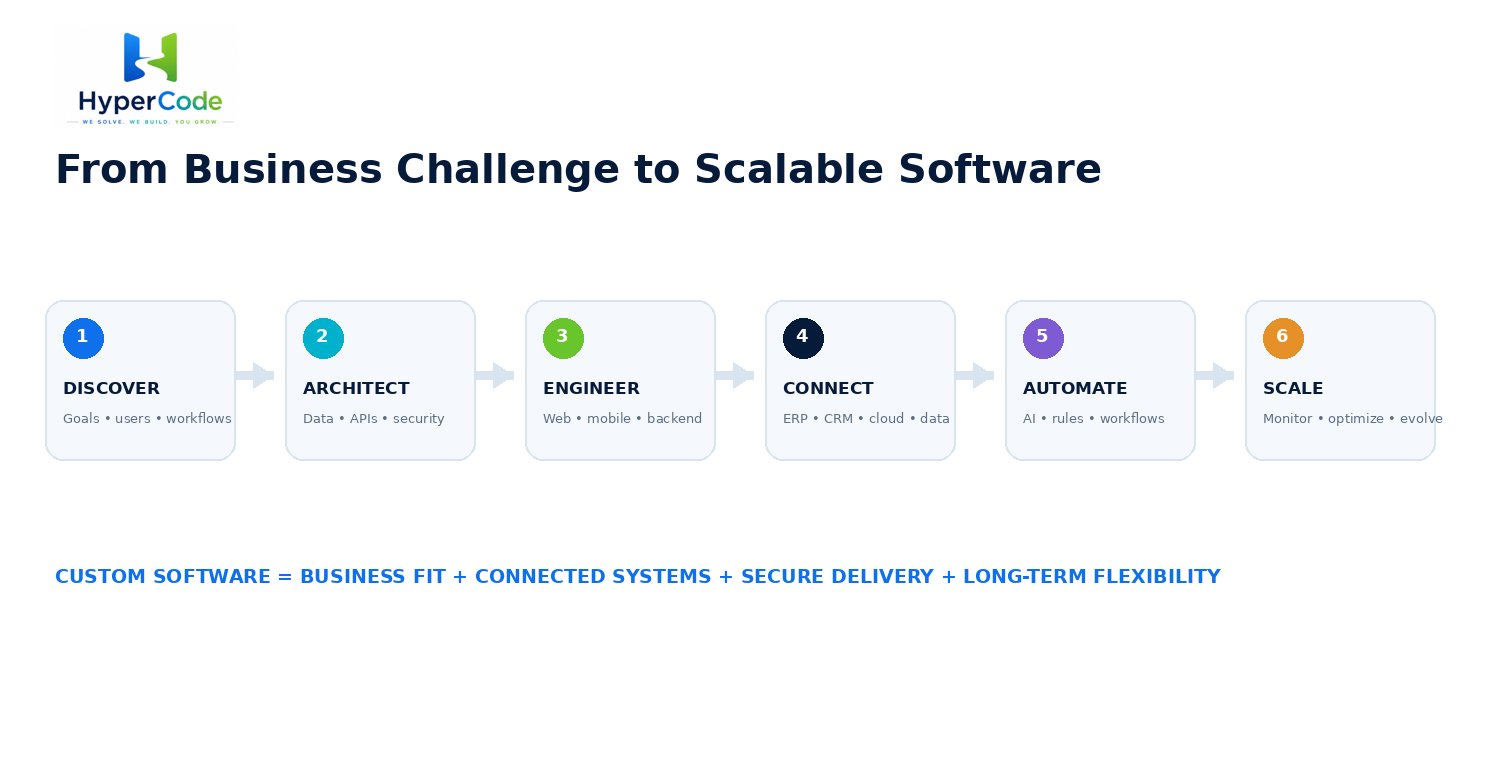
For HyperCode, this approach aligns with a broader delivery model: understand the digital environment, architect the target system, engineer the solution, connect business platforms, automate high-value workflows and scale what works. HyperCode's current capabilities span custom applications, AI and automation, business intelligence, data analytics, data warehousing, web and mobile development, cloud and DevOps, digital transformation and staffing.
Custom enterprise software is a purpose-built application or platform designed around an organization's specific users, workflows, data, integrations, security requirements and business objectives. It can range from an internal operations portal to a customer-facing platform, workflow engine, analytics application, field-service system, partner portal or multi-system enterprise platform. In practice, this is enterprise application development shaped by the business, rather than a generic product stretched around it.
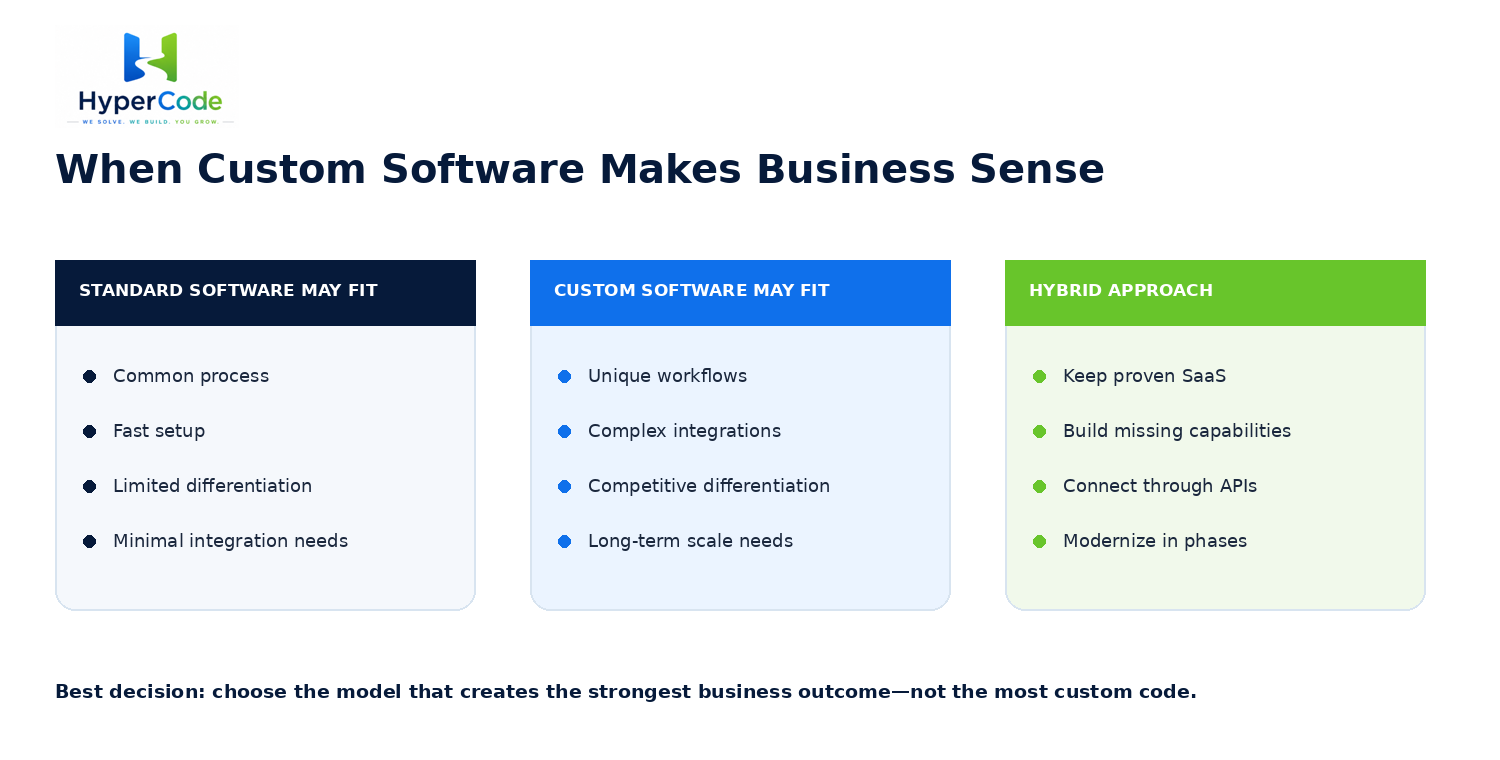
Commercial software is often the right choice when business requirements are common and the product already solves the problem well. Custom development becomes more valuable when the organization's workflow, integrations or competitive requirements cannot be handled cleanly through configuration alone.
A company may have approval rules, operational sequences, pricing logic, customer journeys or compliance steps that do not match a generic platform. Custom business software can model those workflows directly instead of relying on workarounds.
Employees often lose time moving information between systems manually. A custom integration layer can connect business applications through APIs, events and data pipelines so information moves where it is needed. That enterprise integration work is often where operational friction is removed.
A system built for a small team may struggle when users, transactions, locations or data volumes increase. Enterprise architecture can be designed for horizontal scaling, resilient services, workload isolation and future modules.
Internal software should reduce friction, not create it. Interfaces can be designed around actual roles and tasks so users see the information and actions that matter to them.
When operational information is spread across tools, leadership can struggle to get a reliable picture of performance. Custom platforms can consolidate governed data and connect it to analytics and reporting.
When technology is part of how a company serves customers or operates more efficiently, a purpose-built platform can become a business capability rather than merely an IT expense.
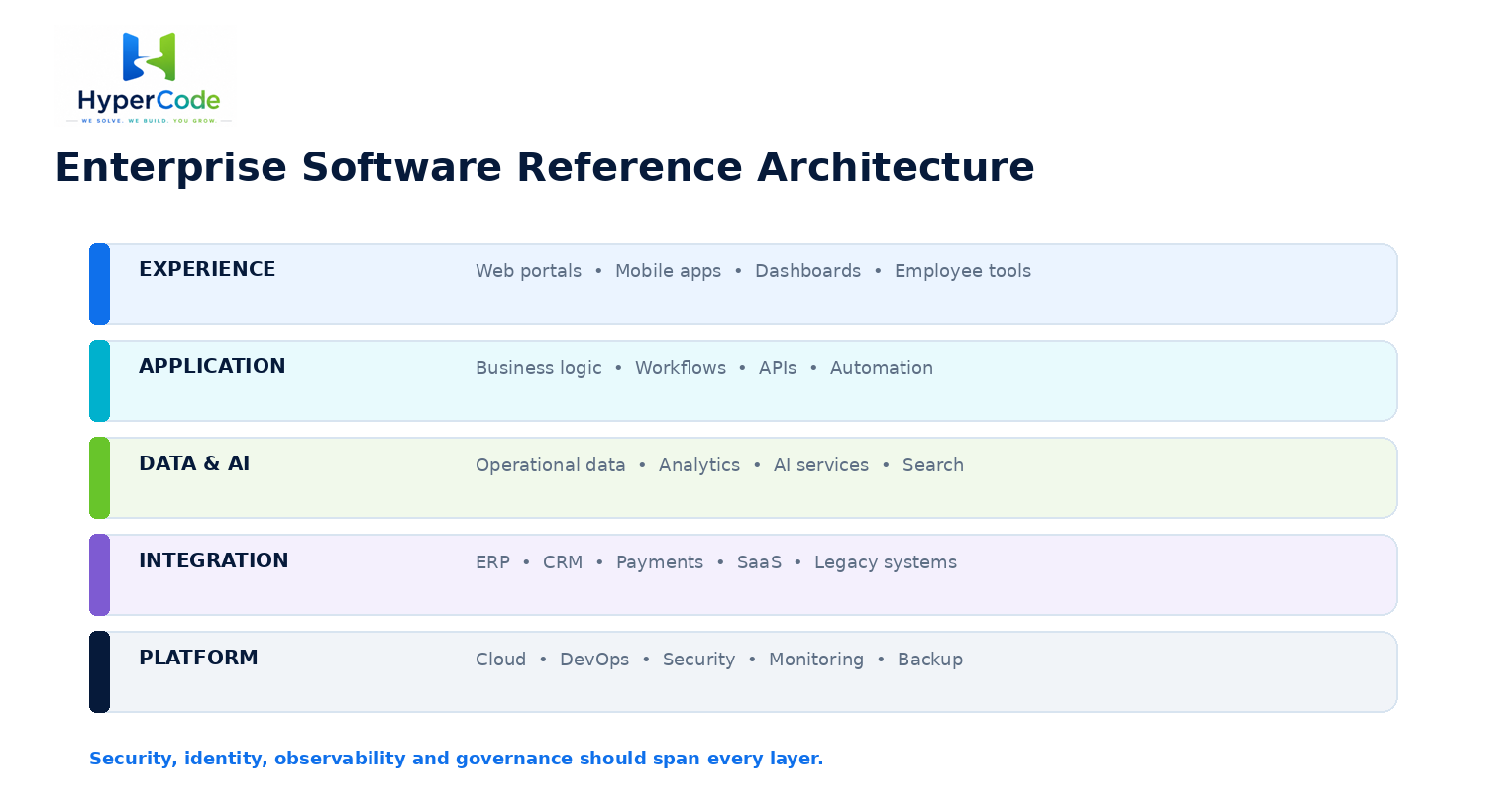
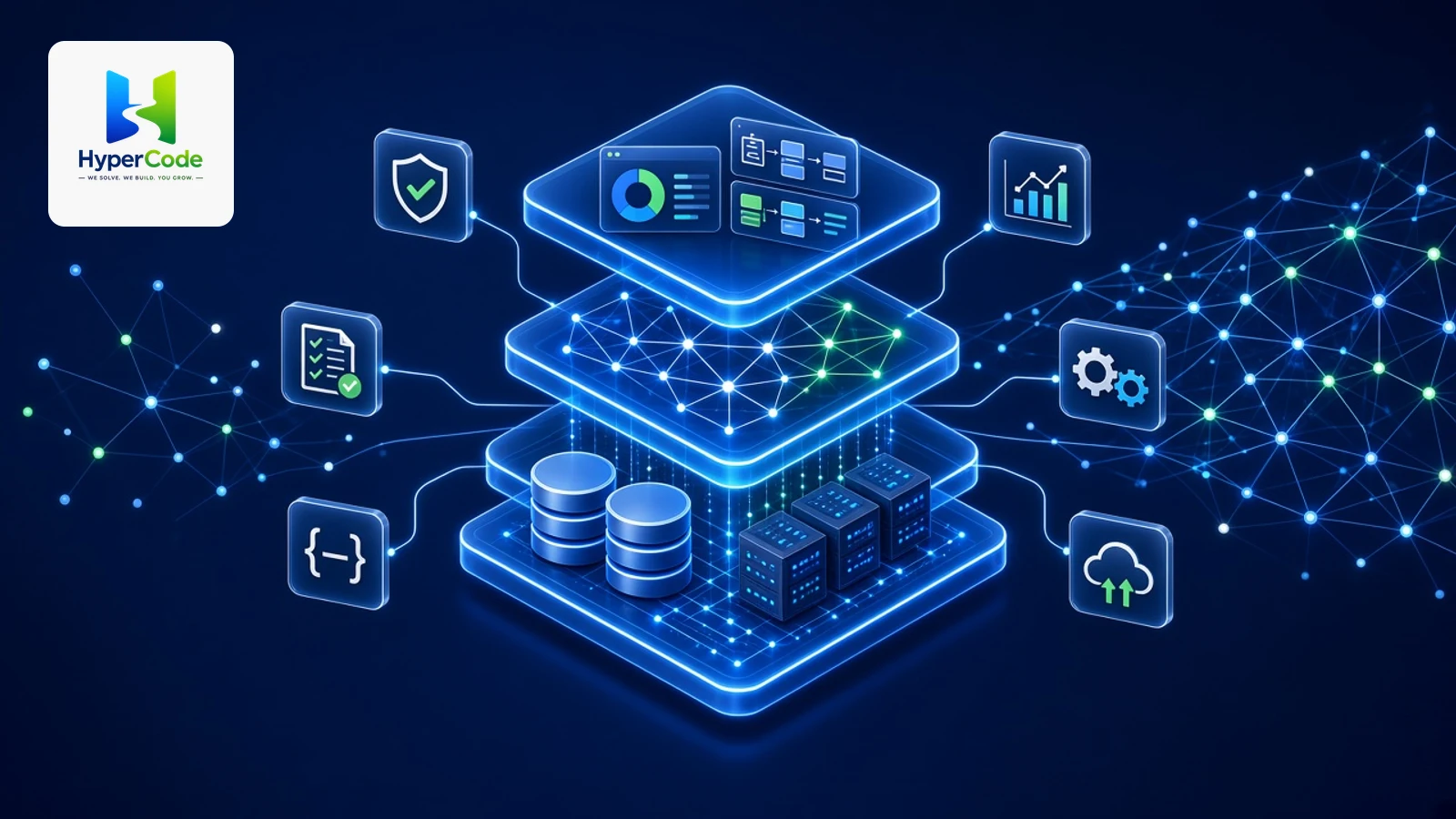
Strong enterprise applications are rarely a single monolithic screen connected directly to a database. Modern systems separate user experience, business logic, data, integrations and infrastructure so each area can evolve without destabilizing the entire platform.
Web applications, mobile apps, dashboards, portals and other interfaces through which users interact with the system.
Business rules, APIs, services, approvals, automation and domain logic that translate business processes into repeatable digital operations.
Operational databases, analytics platforms, search, governed enterprise data and—where useful—AI services that help users retrieve information or automate knowledge-intensive work.
Secure connections to ERP, CRM, payments, SaaS products, legacy systems, identity providers and external APIs.
Cloud infrastructure, DevOps, observability, security controls, backup, resilience and deployment automation that keep the system reliable in production.
Custom enterprise software increasingly includes AI, but AI should be introduced where it improves a measurable workflow rather than added as a decorative feature. Useful patterns include document classification, knowledge retrieval, drafting assistance, customer-service support, anomaly detection, forecasting, intelligent routing and workflow automation.
The most valuable implementations connect AI to trusted enterprise data, existing applications and clear human controls. High-impact actions should include appropriate authorization, validation, logging and escalation. In many environments, the architecture around the model—data access, APIs, identity, observability and governance—is as important as the model itself.
Reduce repetitive manual work, duplicate data entry and unnecessary handoffs.
Create a common digital workflow across departments and business systems.
Add users, modules, locations and integrations without rebuilding the entire solution.
Make governed operational data easier to access through dashboards and analytics.
Apply role-based access, authentication, encryption, logging and environment controls based on the actual use case.
Evolve the software as processes, markets and technology change instead of waiting for a generic vendor roadmap.
Define the business problem, users, workflows, current systems, constraints, risks and measurable success criteria.
Design the application structure, data model, APIs, integrations, security approach, hosting model and delivery roadmap.
Build in small, testable increments. Prioritize high-value workflows and validate them with real users.
Integrate the platform with the systems that already run the business. Avoid creating another isolated application.
Introduce workflow automation and AI only where they reduce effort, improve quality or create measurable business value.
Deploy through controlled environments, monitor performance and usage, improve weak areas and expand the platform based on validated demand.
Digitizing unnecessary steps can make inefficiency faster. Simplify the workflow before encoding it.
Large scope increases risk. Start with a valuable core workflow and expand through measurable releases.
Enterprise value often depends on connected systems. Integration architecture should be part of early design.
Identity, permissions, data handling, logging and infrastructure controls should be designed into the system.
Features shipped are not the same as business value. Track cycle time, adoption, quality, cost, revenue influence or other relevant outcomes.
Production software needs monitoring, maintenance, documentation, upgrades and a clear operating model.
HyperCode is a Schaumburg, Illinois-based technology consulting and engineering company founded in 2014. Its current service portfolio combines custom applications with AI and automation, business intelligence, data analytics, data warehousing, web and mobile development, cloud and DevOps, digital transformation and technology talent capabilities.
HyperCode's published delivery approach emphasizes discovery, architecture, engineering, integration, automation and scale. That structure is especially relevant to enterprise software development because successful applications must work with the organization's existing data, systems and people—not operate as isolated technology.
Custom enterprise software is most valuable when it removes operational friction, connects fragmented systems and creates a foundation the organization can continue to build on. The objective is not to replace every commercial tool or write custom code for its own sake. It is to identify where purpose-built technology creates a meaningful advantage. Software modernization works best when it is sequenced around those advantages.
As enterprises modernize, the strongest software platforms will combine thoughtful user experience, modular architecture, secure integration, trusted data, automation and continuous improvement. Organizations that make those foundations flexible today are better positioned to adopt new capabilities tomorrow without rebuilding the business around another technology constraint.
HyperCode
Technology Consulting
HyperCode is a Schaumburg, Illinois-based technology consulting and engineering company founded in 2014.
HyperCode helps organizations move from business challenge to production-ready digital systems through custom software, AI, cloud, data and enterprise integration.

A practical guide to choosing an enterprise AI platform that can scale with your business across data, security, integration, governance, flexibility, performance, and cost.

How organizations can use generative AI to improve operations, strengthen decision-making, accelerate innovation, and build secure, scalable AI capabilities.

A practical enterprise guide to healthcare AI automation, secure architecture, governance, clinical support, predictive analytics, and responsible implementation.