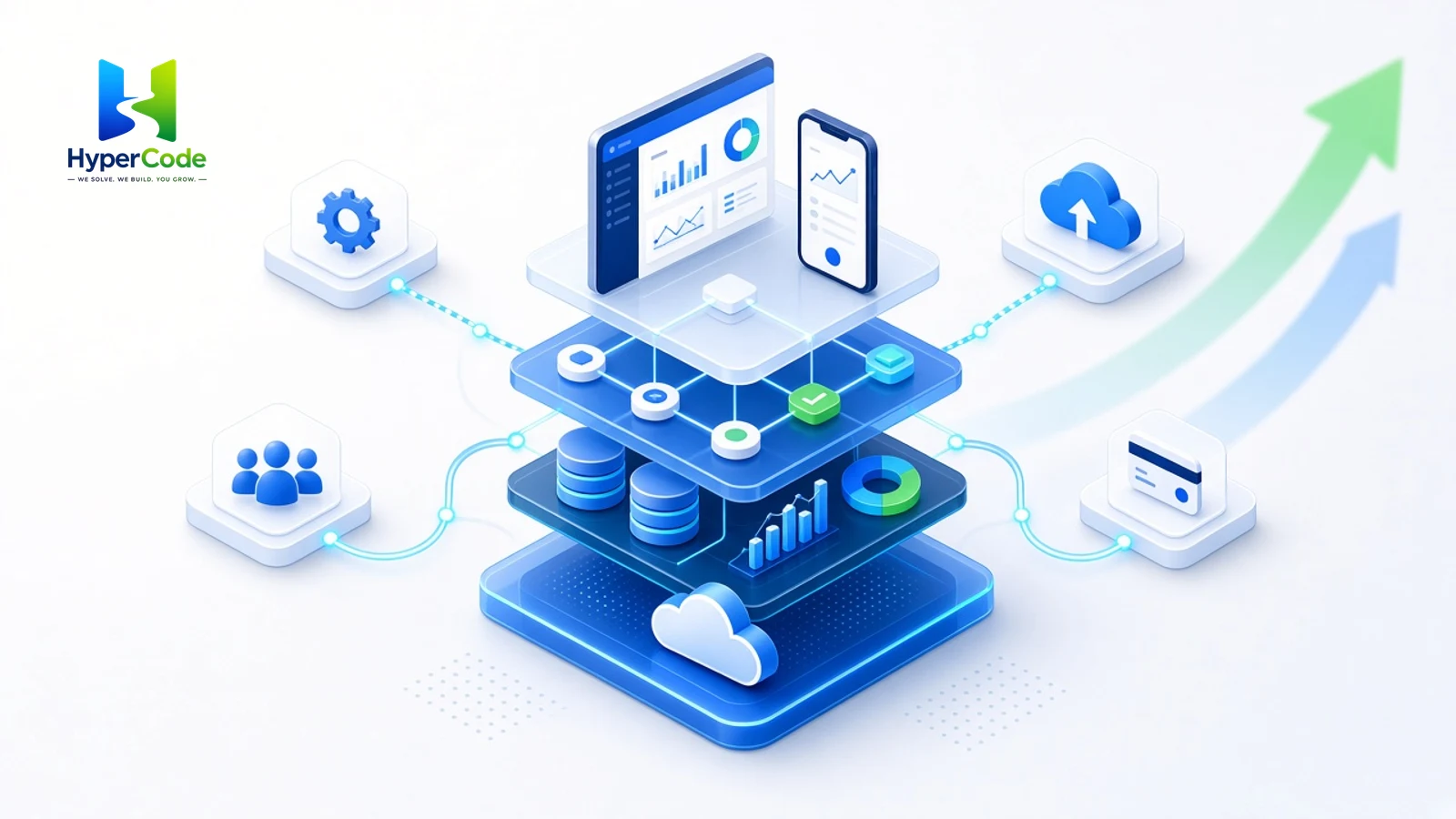

Choosing the Right Enterprise AI Platform for Scale
A practical guide to choosing an enterprise AI platform that can scale with your business across data, security, integration, governance, flexibility, performance, and cost.
HyperCode
Technology Consulting

A business-led guide to moving from AI opportunity to practical, secure and scalable enterprise execution.
Artificial intelligence is moving from experimentation into everyday business operations. For leadership teams, the question is no longer only “what can AI do?” It is where AI can create meaningful value, how it fits into existing systems, and what foundations are needed to use it responsibly at scale.
This guide sets out a practical roadmap for building an enterprise AI strategy in 2026: one that starts with business goals, prepares the right data and technology, and creates a credible path from focused implementation to broader adoption.
01 · Understanding Enterprise AI
An enterprise AI strategy is not simply choosing an AI model or purchasing an AI tool. It is a business-led plan for identifying the right opportunities, preparing data and technology, establishing governance and creating a path from focused implementation to broader adoption.
The purpose is not to adopt AI because it is available, but to connect intelligent capabilities to outcomes the organization genuinely cares about.
What a strategy connects
From business goals to business impact
That distinction is important. A successful demonstration can show what a model is capable of; an enterprise solution must work within real processes, systems, data environments and operating responsibilities.
The strategy conversation
Business goals come first. Technology follows.
Where can AI help?
What is ready?
Who will use it?
How will it grow?
Strategy is what connects a promising AI demonstration to a solution that works inside the business.
02 · Why AI Strategy Matters
The pace of AI innovation, the availability of enterprise data and rising expectations for faster digital experiences are changing how organizations approach technology investment. Businesses are moving from experimentation toward operational AI.
In this environment, an AI strategy creates discipline. It helps leaders focus resources on opportunities that support business priorities instead of accumulating disconnected pilots and tools.
The shift
From technology-first to outcome-first
Old question
“Where can we use AI?”
Transformation
Better question
“Which business outcome should improve, what needs to change, and how will we measure success?”
A strong strategy can support greater operational efficiency, more informed decision-making, enhanced customer experiences and new digital capabilities. It also helps decide which initiatives deserve investment, what risks must be addressed and what needs to be ready before a pilot can become a production capability.
Start with a real operational, customer or decision-making priority.
Consider data, integration, governance and adoption before expansion.
Asking the outcome-first question connects AI initiatives to measurable value instead of to the technology itself.
03 · Practical AI Roadmap
A successful enterprise AI strategy follows a structured path. The six stages below reflect HyperCode’s execution model: understand the problem, design the right foundation, build the solution, connect it to the business, automate where it creates value, and scale what works.
The practical roadmap
Six stages from AI idea to enterprise impact
Define the business challenge and opportunity.
Design data, technology and solution architecture.
Build applications and AI-enabled capabilities.
Connect systems, data and workflows.
Embed intelligence into practical processes.
Expand what works and measure the impact.
Each stage builds on the one before it. Architecture decisions account for integration, security and scalability from the start, and solutions are built and tested in the context of the real business environment rather than in isolation.
Understand the problem first, design for production from the beginning, and scale what works.
04 · Enterprise AI Foundation
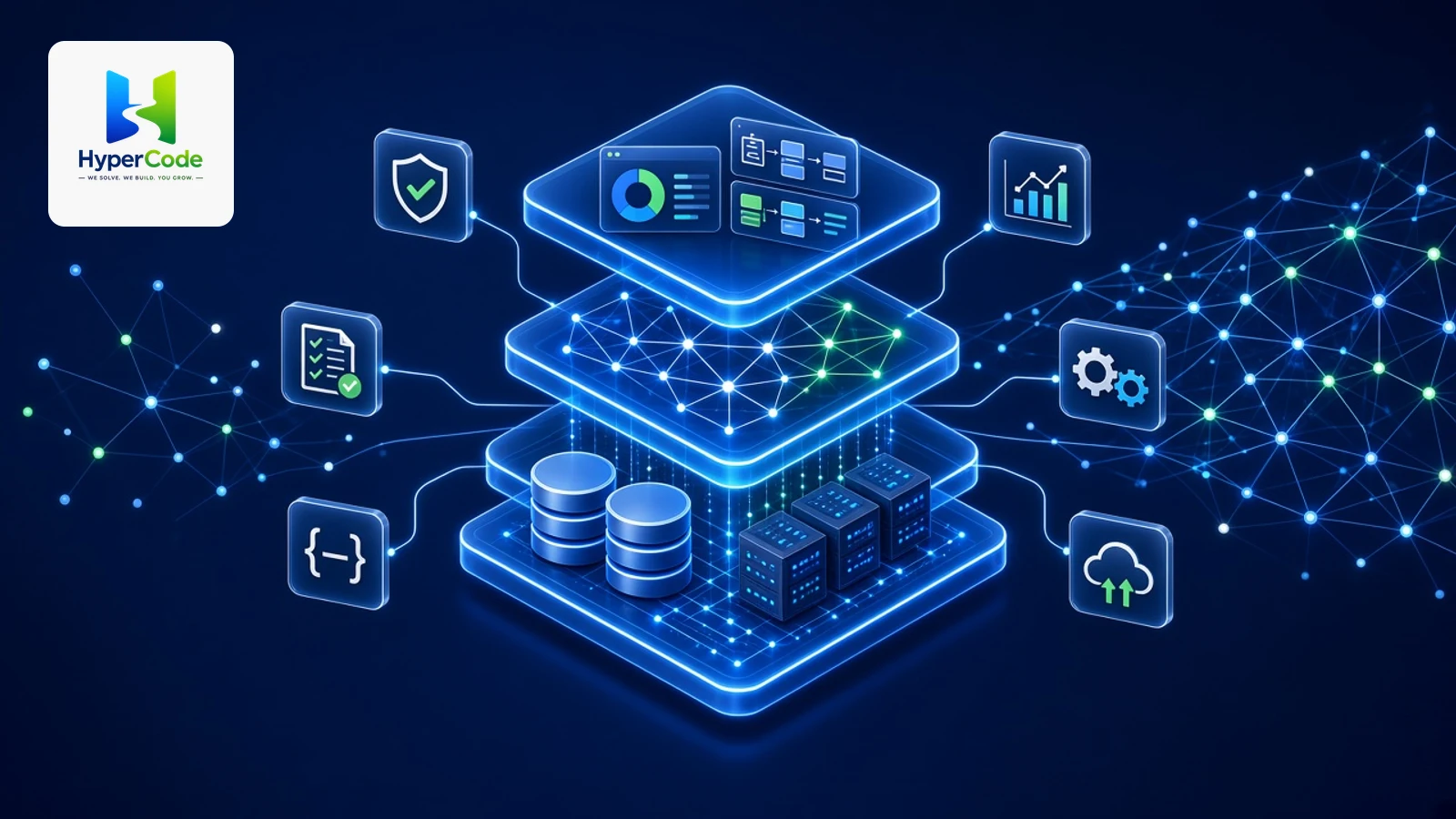
A model by itself does not create enterprise value. AI becomes useful when it is connected to trusted data, applications, workflows and the systems that run the business. The surrounding architecture matters just as much as the intelligence inside the model.
Enterprise AI foundation
The layers that turn AI into business outcomes
Business outcomes
Applications & workflows
Integration & orchestration
AI & automation
Data foundation
Supporting all layers
05 · Common AI Challenges
The potential of AI is significant, but implementation can expose weaknesses that already exist in an organization’s data, systems or operating model. Understanding these challenges early turns them into design priorities rather than late-stage obstacles.
Common enterprise AI challenges
Six challenges to design for early
Data may exist across disconnected systems or have inconsistent quality.
Existing infrastructure may make modern AI integration difficult.
Sensitive enterprise data requires appropriate safeguards.
Technology creates value only when teams can effectively use it.
Technical performance must be connected to business outcomes and KPIs.
Successful experiments still need production integration, ownership and governance.
Challenges are not reasons to avoid enterprise AI. They reveal which foundations the organization needs to strengthen.
Adoption deserves particular attention. It requires clear ownership, appropriate support and workflows designed around how teams actually work.
06 · How HyperCode Helps
HyperCode brings together AI, data, software engineering, cloud and digital transformation capabilities to help organizations move from business challenges to practical technology solutions. The focus is on building technology around real business requirements, not simply adding AI as another layer.
HyperCode
Capabilities that connect strategy to execution
AI-powered applications and workflow automation.
Dashboards, reporting and decision support.
Actionable insight from enterprise data.
Scalable foundations for analytics and AI.
Software engineered around business requirements.
Scalable environments and modern delivery.
Modernize platforms, processes and technology ecosystems.
Explore the related services: AI workflow automation, business intelligence, data warehousing, custom software development, cloud migration and digital transformation consulting.
For organizations still shaping their direction, AI consulting and data engineering are often practical starting points.
07 · AI Readiness
Before expanding an AI initiative, leaders should be able to answer a few practical questions. Is there a clear business case? Is the data reliable and governed? Are people, processes and safeguards ready?
Readiness check
Enterprise AI readiness checklist
A defined business problem and measurable expected outcome.
Relevant, reliable and appropriately governed data.
Architecture, applications and integrations designed for the required scale.
Security, privacy, governance and human oversight considered.
People, processes and ownership prepared for implementation.
A clear path from focused implementation to broader business value.
If any of these areas is unclear, that is where the strategy needs attention before the initiative expands.
08 · Final Takeaway
An enterprise AI strategy gives the organization a clear direction: start with the business outcome, prepare the foundations, and grow from focused implementation to enterprise value.
AI strategy is not about chasing the next tool.
It is about building what your business needs next.
Once the strategy is in place, platform decisions follow. Read Choosing the Right Enterprise AI Platform for Scale and How Enterprise Generative AI Drives Strategic Innovation.
HyperCode
Technology Consulting
Consultor en HyperCode especializado en soluciones en la nube, sistemas de bases de datos avanzados y arquitecturas empresariales estratégicas.
HyperCode helps organizations connect business strategy, data, AI, software engineering, cloud and automation to build practical technology solutions around real business requirements.

A practical guide to choosing an enterprise AI platform that can scale with your business across data, security, integration, governance, flexibility, performance, and cost.

How purpose-built enterprise software helps organizations connect systems, automate workflows, modernize operations and create a scalable foundation for growth.

Cómo las organizaciones pueden utilizar la IA generativa para mejorar las operaciones, fortalecer la toma de decisiones, acelerar la innovación y construir capacidades de IA seguras y escalables.

Una guía empresarial práctica sobre automatización de IA en salud, arquitectura segura, gobernanza, soporte clínico, análisis predictivo e implementación responsable.