
Why Enterprises Need Custom Software Development Solutions

HyperCode

Technology Consulting

October 7, 2026
7 min read
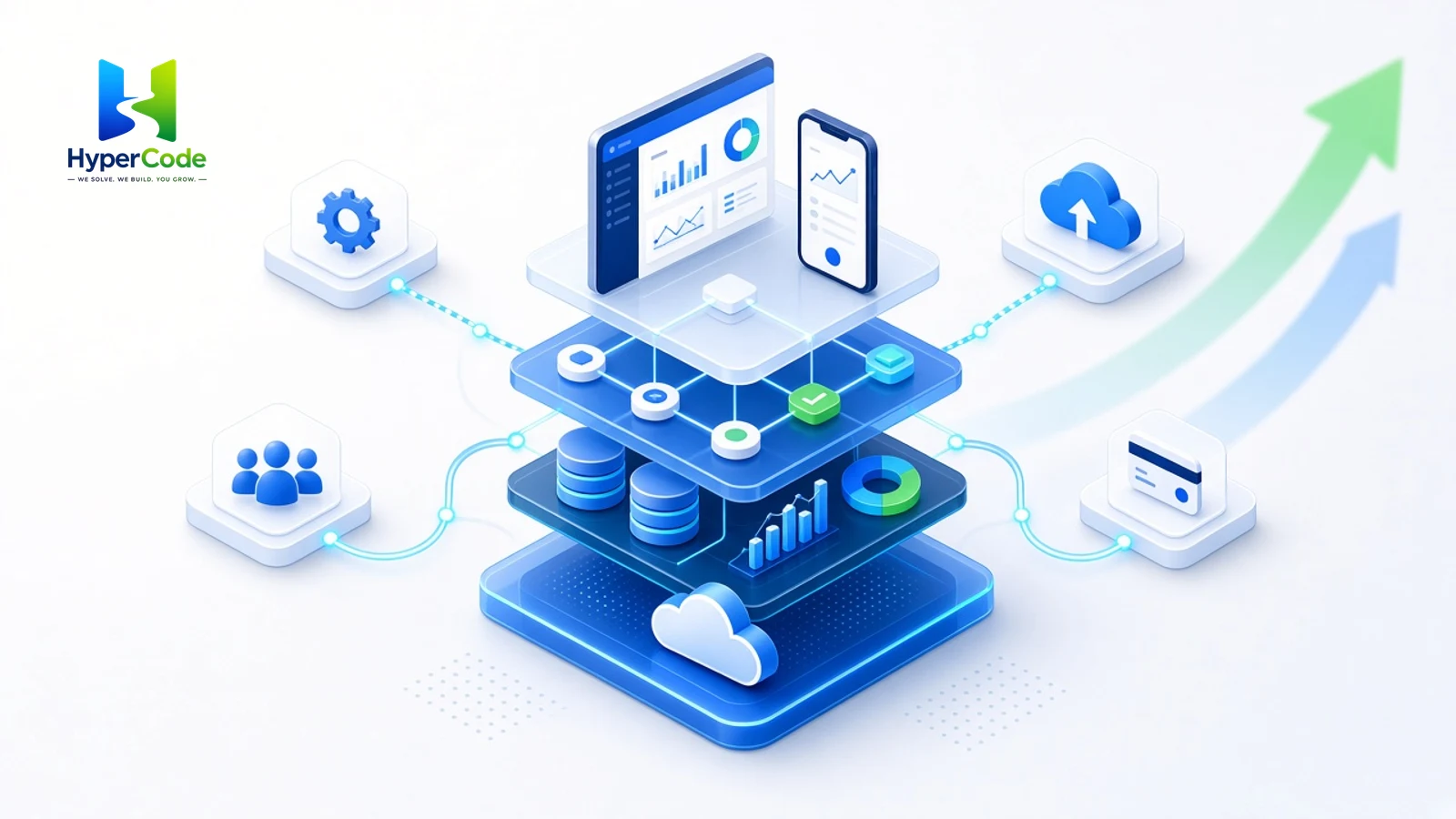
HyperCode software team designing a custom enterprise application around business workflows, integrations, data, and user needs.
Back to Articles

Share Article

Why tailored technology is becoming essential for organizations whose processes, customers, data, and ambitions no longer fit neatly inside generic software.

Enterprise software decisions used to be framed as a simple choice: buy a product or build one. Today the more useful question is how well the technology fits the business it is meant to serve. Custom software development solutions matter when processes, customers, data and integrations are too important or too distinctive to be forced into generic functionality.

Animated overview

From Business Problem to Business Value

  1. Business problem
  2. Discover
  3. Design
  4. Develop
  5. Deploy
  6. Evolve
  7. Business value
Workarounds give way to a solution that is discovered, designed, developed and deployed around the business, connected to APIs, data and cloud services, and then evolved as needs change. The bars are conceptual and do not represent measured results.
In this article
  1. When Off-the-Shelf Software Stops Being Enough
  2. Custom Software Starts With the Business Problem
  3. A Closer Fit to Real Workflows
  4. Integration by Design
  5. Room for Differentiation
  6. A Foundation That Can Evolve
  7. The Impact Goes Beyond the Application
  8. From Business Vision to a Solution That Evolves
  9. Where HyperCode Fits

01 | The Business Reality

When Off-the-Shelf Software Stops Being Enough

Off-the-shelf software has helped organizations solve common business problems quickly. It provides established features, familiar interfaces, and a defined product roadmap. For many standard requirements, that approach can be entirely appropriate.

The difficulty begins when the organization itself is not standard. Enterprise processes are shaped by years of operating experience, customer expectations, industry requirements, internal approvals, data structures, and integrations with other systems. As those factors become more complex, a generic product can start creating friction rather than removing it.

The first signs are often small: employees export data into spreadsheets, enter the same information more than once, maintain workarounds outside the official system, or depend on manual steps because the software cannot quite support the way work actually happens.

The real challenge is not the lack of software. It is the lack of software that truly understands the business.

Over time, these compromises can become expensive. They consume employee time, make processes harder to change, introduce additional points of failure, and make it more difficult to respond when customers, regulations, or business priorities change.

This is where custom software development solutions become relevant: not because every enterprise should build everything itself, but because some business capabilities are too important, too distinctive, or too constrained by existing tools to remain dependent on generic functionality.

Two valid approaches

Off-the-Shelf vs. Custom Software

Off-the-shelf software

Best for

  • Common, well-understood capabilities
  • Standard requirements that fit established features
  • Capabilities that are not strategically differentiating

Potential constraintBusiness adapts to software

Custom software

Best for

  • Important or distinctive business capabilities
  • Complex workflows, data and integrations
  • Processes that need greater control over how they evolve

Core advantageSoftware adapts to the business

Both have a place in an enterprise. The right choice depends on how common, important and distinctive the capability is.

02 | The Value of Fit

Custom Software Starts With the Business Problem

Custom software is not simply a decision to write code instead of buying a product. It is a decision to design technology around a particular business context. The starting point is not a feature catalogue. It is the problem the organization needs to solve and the outcome it needs to create.

That distinction changes the development conversation. Instead of asking which existing product comes closest to the requirement, the team can ask what the ideal workflow should look like, what information needs to move through it, which systems must connect, where decisions happen, and where technology can remove unnecessary effort.

Key idea

The value is in the fit.

The value of fit

What Custom Software Is Designed Around

Custom software

  • Real workflows
  • Integration by design
  • Business rules
  • Customer experience
  • Data
  • Scalability
  • Security
  • Automation & AI readiness

A Closer Fit to Real Workflows

A tailored system can reflect the actual sequence of work rather than asking employees to adapt their process to a generic configuration. That can reduce workarounds and make the software feel like part of the operation.

Integration by Design

Enterprise software rarely stands alone. Custom development can be designed around existing databases, APIs, identity services, finance platforms, partner systems, cloud environments, and other applications that already matter to the business.

  • Databases
  • APIs
  • Identity services
  • Finance platforms
  • Partner systems
  • Cloud environments
  • Existing applications

When integration is part of the design rather than an afterthought, information can move between systems with less manual effort. That same foundation supports data engineering, business intelligence and cloud migration work as the environment grows.

Room for Differentiation

Some capabilities are simply necessary to operate. Others are what make an organization distinctive. Custom development gives enterprises greater control over the technology behind those differentiated processes, products, and experiences.

A Foundation That Can Evolve

Requirements change. New channels appear, teams grow, data volumes increase, and business priorities shift. A solution designed for maintainability, scalability, security, and integration can evolve instead of becoming another constraint.

The best custom software does not make the business adapt to technology. It makes technology adapt to the business.

That does not mean packaged software has no place in an enterprise. Standard products can be valuable where the capability is common, well understood, and not strategically differentiating. The case for custom development is strongest where the organization needs greater control over an important capability.

03 | From Technology to Business Value

The Impact Goes Beyond the Application

The strongest custom software projects are not technology projects in isolation. They change the way work gets done. A well-designed solution can connect information, remove unnecessary handoffs, improve visibility, and make it easier for teams to respond when the business changes.

Business value

Five Outcomes Beyond the Application

  • Customer experience

    More consistent and responsive journeys.

  • Operational efficiency

    Fewer manual handoffs and duplicate steps.

  • Decision-making

    Better access to useful operational information.

  • Agility

    Technology easier to change as business needs change.

  • Automation & AI foundation

    Reliable workflows, data and integrations ready for future intelligence.

Stronger customer experiences

When technology is built around the customer journey, organizations can create more consistent interactions, faster responses, and experiences that reflect how customers actually engage with the business.

Greater operational efficiency

Connected workflows can reduce duplicate entry, repetitive approvals, manual handoffs, and unnecessary movement between disconnected tools.

Better decision-making

A well-designed system can organize operational information so teams can access, interpret, and use it more effectively when decisions need to be made.

Higher agility

Technology becomes easier to adapt when architecture, integrations, data, and deployment practices are designed with change in mind.

A stronger foundation for automation and AI

When workflows, data, security, and integrations are intentionally engineered, future automation and AI initiatives have a more reliable environment in which to operate. That is the groundwork AI workflow automation depends on.

Key idea

The important measure is not how much technology was built. It is what became possible because the technology fit the business better.

04 | Building for What Comes Next

From Business Vision to a Solution That Evolves

A successful custom software development solution begins long before the first line of production code. It starts with understanding the business problem, the people affected by it, the existing technology environment, and the future the organization is trying to reach.

The journey

Discover, Design, Develop, Deploy, Evolve

  1. Discover

    Goals, users, workflows and constraints

  2. Design

    Experience and architecture

  3. Develop

    Manageable, validated increments

  4. Deploy

    Integrate, test, observe and adopt

  5. Evolve

    Improve as needs change

Evolve feeds the next round of discovery. Custom does not mean static.

Discover. Understand goals, users, workflows, constraints, dependencies, and opportunities before deciding what to build.

Design. Translate those findings into an experience and architecture that balance business value, usability, security, integration, and maintainability.

Develop. Build in manageable increments, validating assumptions while keeping quality, scalability, and maintainability part of the engineering process.

Deploy. Integrate, test, observe, and introduce the solution into the real operating environment with the support needed for reliable adoption.

Evolve. Continue improving the product as users provide feedback, business requirements change, and new opportunities emerge. Custom does not mean static; its value is the ability to evolve.

The real opportunity is not simply to replace an existing tool. It is to build a digital capability that gives the organization more control over how it serves customers, operates internally, and responds to what comes next. For a deeper look at each stage, read The Lifecycle of Custom Software Design and Development.

05 | Where HyperCode Fits

Where HyperCode Fits

At HyperCode, custom software development connects business goals with practical engineering, from discovery and architecture through development, integration, deployment, and continued evolution.

The HyperCode approach

From Business Goals to Business Value

  1. Business goals
  2. Discovery
  3. Architecture
  4. Custom engineering
  5. Integration
  6. Deployment
  7. Continuous evolution
  8. Business value

Explore the services behind this approach: custom software development, web development services, digital transformation consulting and AI workflow automation. When existing platforms are part of the picture, read Enterprise Software Development: Modernizing Core Systems and Scaling Success with Custom Enterprise Software.

When the business is unique, the technology should have room to be unique too.

Start with the business problem, design around the way work actually happens, and build a solution that can keep evolving.

  • WE BUILD.
  • WE SOLVE.
  • WE GROW.

About the Author

HyperCode

Technology Consulting

HyperCode is a Schaumburg, Illinois-based technology consulting and engineering company founded in 2014.

Ready to Build Software Around the Way Your Business Actually Works?

HyperCode helps organizations turn unique business requirements into scalable custom applications through discovery, architecture, software engineering, integration, deployment, and continuous improvement.

Read Article

Related Articles