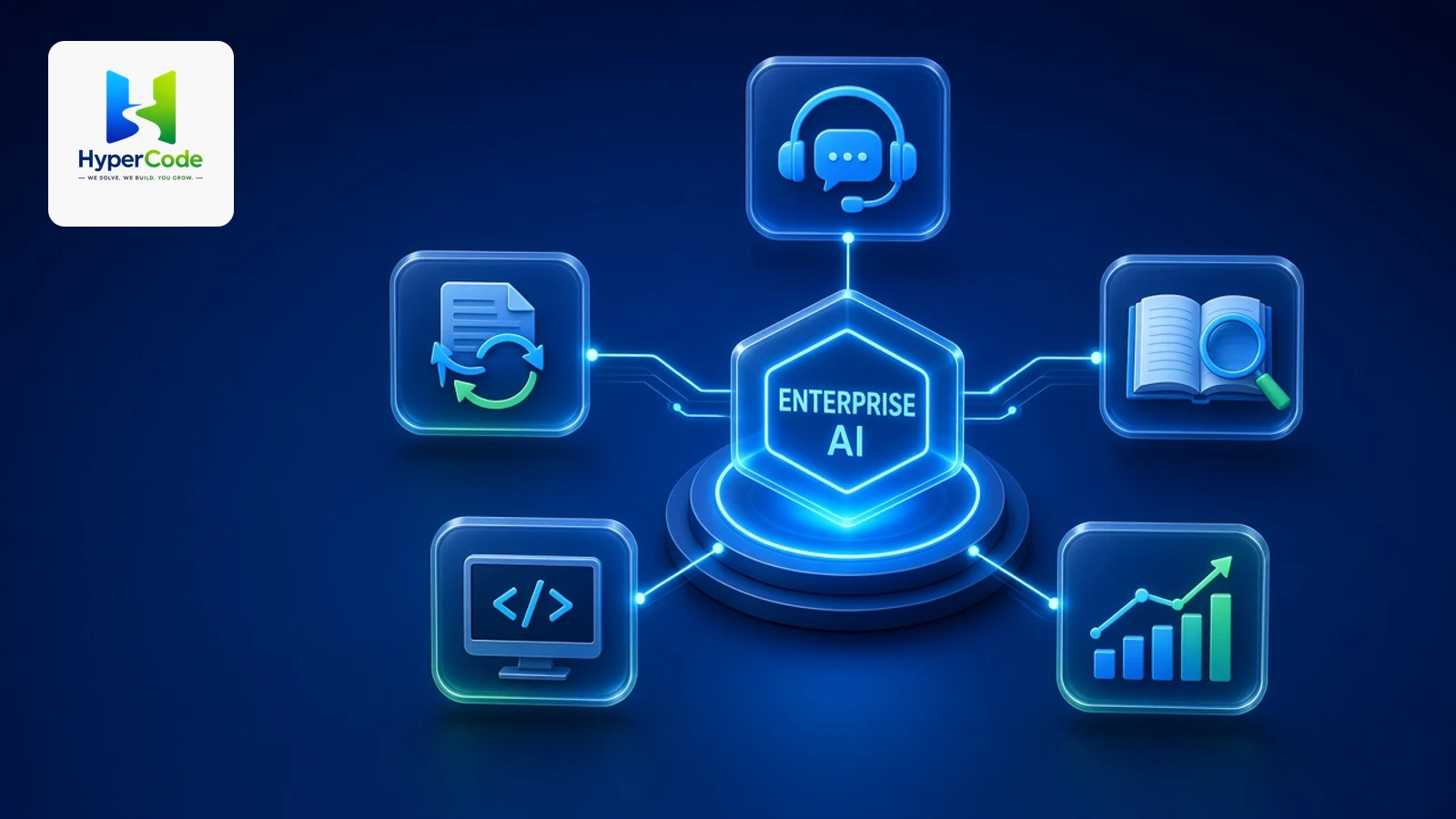
IA
Top 5 AI Enterprise Software Use Cases for 2026
A practical guide to where enterprise AI software creates measurable business value.
October 1, 2026Leer Resumen
HyperCode
Technology Consulting

A practical framework for turning automation investment into measurable business value
Enterprise automation tools are easy to buy and harder to turn into lasting value. The return comes from how well automation improves the way work moves through the business, not from how many tasks a tool can run.
This guide sets out a practical framework for building the business case, choosing where to automate, combining rule-based automation with AI, keeping people in control, and measuring ROI across the whole process.
Animated overview
The Automation Value Loop

Business
value
Each turn of the loop improves
01 | The ROI Question
Enterprise automation has moved beyond isolated task automation. The larger opportunity is to connect workflows, applications, data and intelligent capabilities so that an entire business process works with less friction.
That distinction matters because the value of automation is rarely captured by the software alone. A task may become faster, but the business case becomes stronger when handoffs are reduced, exceptions are surfaced earlier, information reaches the right person sooner, and employees can spend more time on work that requires judgment.
The strongest automation business cases connect technology activity to a business metric that leadership already cares about.
Return on investment should be viewed as a combination of financial, operational and strategic outcomes. A useful business case considers what the process costs today, what changes after automation, and how those changes affect capacity and service.
Framework
From Automation Investment to ROI
Automation value can show up in several places:
Lower operating cost and better use of employee capacity
Shorter cycle times and higher throughput
Fewer errors, exceptions and avoidable rework
Improved employee productivity and experience
More consistent customer and service delivery
Greater ability to scale without proportional manual effort
The point is not simply to automate more tasks. It is to make the way work moves through the organization faster, clearer and more measurable.
02 | Build the Business Case
A common automation mistake is choosing a platform before understanding the workflow. A stronger business case begins with the process itself: where work enters, where information moves, where decisions happen, and where delays or errors occur.
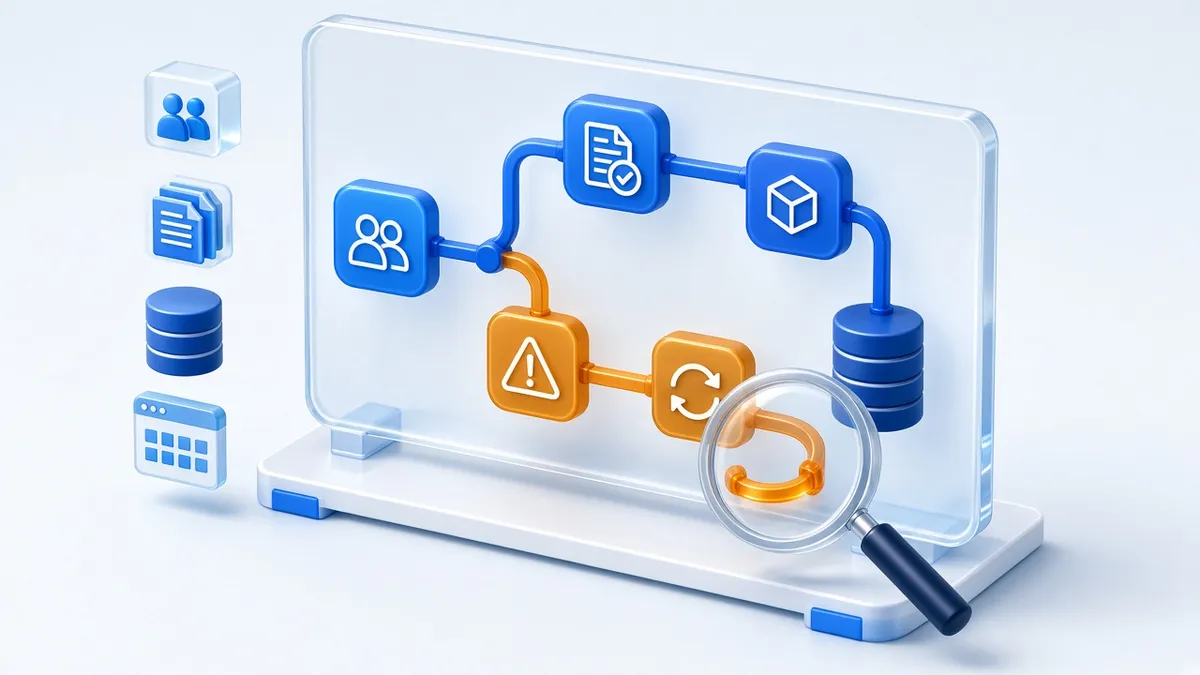
Document the people, systems, data sources, approvals, exceptions and handoffs involved. This creates a baseline for measuring improvement and exposes the parts of the process where automation can have the greatest effect.
High transaction volume, repetitive effort, long waiting periods, manual reconciliation, frequent rework and costly errors can all indicate potential value. The right opportunity is usually one where the business outcome can be measured.
Compare expected impact with data readiness, integration complexity, security requirements, change effort, and the number of exceptions that still require human judgment.
A good automation roadmap does not ask, “What can we automate?” It asks, “Where can automation improve the way the business works?”
Every automation initiative can follow the same five-step path, from understanding today’s performance to expanding what works.
Value path
Baseline to Scale in Five Steps
Understand current process performance
Select valuable, feasible opportunities
Connect workflows, systems and data
Track business and operational outcomes
Expand what creates measurable value
03 | Practical Use Cases
Enterprise automation tools can create value across departments. The most durable opportunities tend to sit where repetitive work, multiple systems and a measurable business outcome meet.
By business function
Five Areas Where Automation Pays Off
Automation can reduce manual data entry, document routing, reconciliation, approval chasing and recurring reporting while giving teams more capacity for analysis and exception handling.
Customer workflows often involve emails, cases, documents, knowledge and multiple applications. Automation can classify requests, route work, retrieve information, prepare responses and keep records synchronized.
Automation can support deployment workflows, monitoring, ticket classification, repetitive maintenance, documentation and developer processes. Connected observability and governance make these workflows easier to manage.
Data automation can connect sources, validate information, transform data, refresh reporting pipelines and surface exceptions, creating a stronger foundation for analytics and faster access to trusted information.
Internal processes often depend on searching documents, answering recurring questions, preparing summaries and moving requests between teams. Intelligent automation can reduce administrative friction while keeping people involved when judgment matters.
Automation creates more durable value when it improves an end-to-end process rather than optimizing one isolated task.
04 | Automation + AI
Rule-based automation remains highly effective for predictable, repeatable work. AI adds another layer for processes involving language, classification, summarization, context or less-structured information. Together, they can support workflows that were previously difficult to streamline.
AI can help interpret documents, classify requests, summarize information, retrieve enterprise knowledge, prepare drafts, identify exceptions and support employees before a human decision is made.
Automation should not remove judgment where accuracy, compliance, customer impact or financial consequences matter. A practical model can be AI-assisted preparation followed by human review and an authorized system action.
Operating model
Intelligent Automation with Human Oversight
Supported by
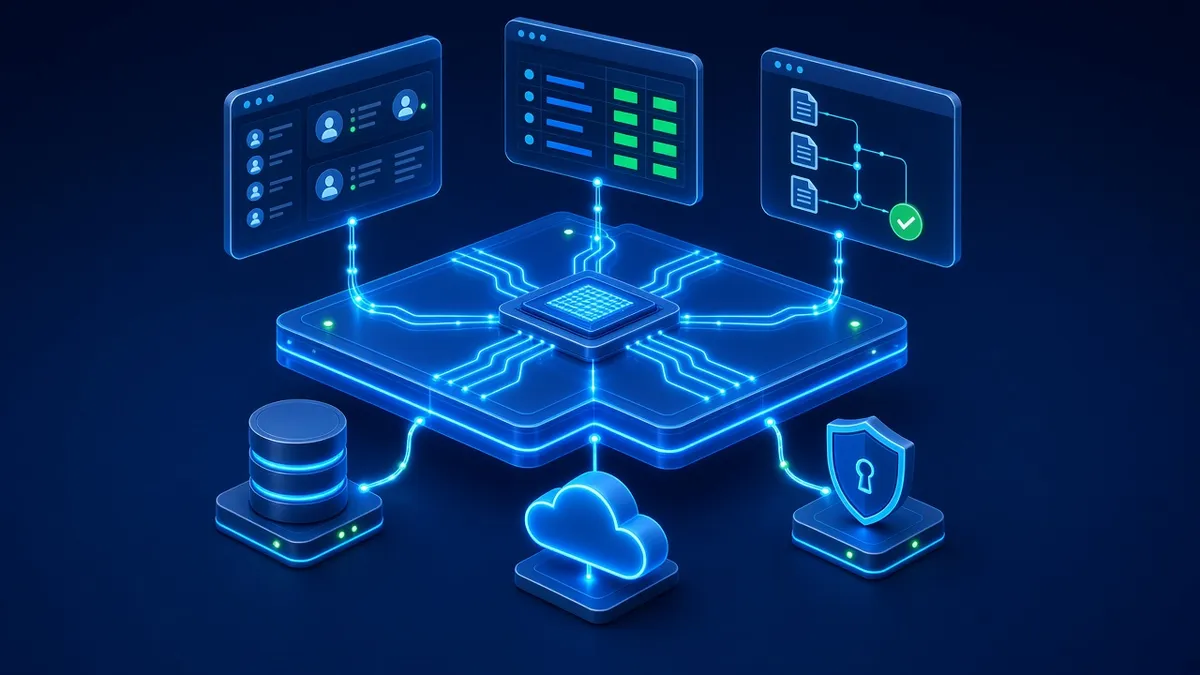
APIsIdentityEnterprise dataApplicationsCloudMonitoringAPIs, data platforms, identity, applications, workflow logic and cloud infrastructure form the integration layer that turns automation into an enterprise capability. A sophisticated tool has limited value if it remains disconnected from the systems where work actually happens.
Architecture
The Integration Layer
Automation & AI capabilities
Integration layer
Real enterprise operations
AI can make automation more capable. Integration makes it useful inside the enterprise.
A controlled pilot should establish what works, what needs adjustment and what governance is required. Scaling then becomes a matter of strengthening architecture, integration, security, adoption and measurement rather than simply adding more tools.
Scaling
What a Pilot Proves, and What Scale Requires
Controlled pilot establishes
Production scale strengthens
05 | From Investment to Enterprise Value
ROI becomes easier to manage when the baseline is established before implementation. The business should know what the process costs, how long it takes, how often errors occur, and what capacity is consumed.
ROI = (Business Benefits − Automation Investment) ÷ Automation Investment
ROI measurement
What Goes Into the Calculation
Automation investment
Business benefits
A narrow calculation may count only labor hours saved. A stronger assessment also considers cycle time, throughput, quality, customer experience, risk, and the ability to handle higher volumes without proportional increases in manual effort.

Labor and capacity
Cycle time and throughput
Quality, rework and exceptions
Customer and service impact
Risk, auditability and compliance
Technology, integration and maintenance cost
HyperCode engineers custom software, AI automation, cloud, data and enterprise platforms around real business operations. Its capabilities span AI & Automation, Business Intelligence, Data Analytics, Data Warehousing, Custom Applications, Cloud & DevOps and Digital Transformation.
For automation initiatives, this connected view matters. HyperCode’s Discover → Architect → Engineer → Connect → Automate → Scale approach provides a practical path from business requirements to connected, production-ready solutions.
HyperCode delivery model
From Business Requirement to Production-Ready Automation
Business process + measurable outcome
Systems + data + security + workflow
Applications + automation capabilities
APIs + systems + enterprise data
Rules + AI + workflow orchestration
Measure + optimize + expand
Capabilities
Explore the services behind this approach: AI workflow automation, custom software development, business intelligence, data warehousing, data engineering, cloud migration and digital transformation consulting.
The strongest automation investment is one that:
Improves a measurable business outcome
Fits the way work actually happens
Connects to the systems that matter
Continues to create value after launch
The goal is not to automate more work. It is to create a better way for the business to work.
Related reading: Top 5 AI Enterprise Software Use Cases for 2026 and How to Build an Enterprise AI Strategy.
HyperCode
Technology Consulting
Consultor en HyperCode especializado en soluciones en la nube, sistemas de bases de datos avanzados y arquitecturas empresariales estratégicas.
HyperCode helps organizations connect workflows, applications, data, AI and cloud technologies to build practical automation solutions around real business operations.
A practical guide to where enterprise AI software creates measurable business value.

A business-led guide to moving from AI opportunity to practical, secure and scalable enterprise execution.
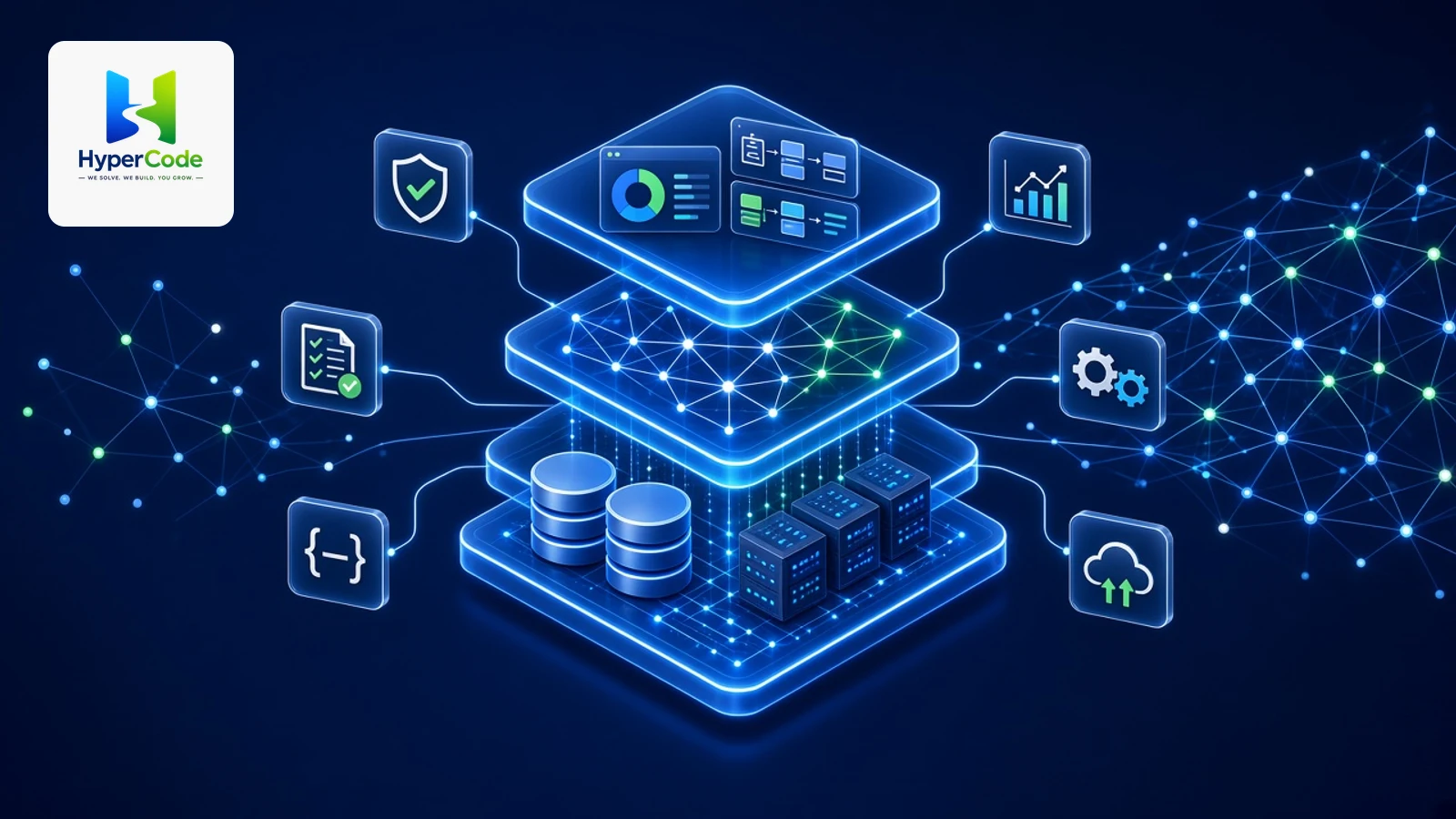
A practical guide to choosing an enterprise AI platform that can scale with your business across data, security, integration, governance, flexibility, performance, and cost.
How purpose-built enterprise software helps organizations connect systems, automate workflows, modernize operations and create a scalable foundation for growth.

Cómo las organizaciones pueden utilizar la IA generativa para mejorar las operaciones, fortalecer la toma de decisiones, acelerar la innovación y construir capacidades de IA seguras y escalables.

Una guía empresarial práctica sobre automatización de IA en salud, arquitectura segura, gobernanza, soporte clínico, análisis predictivo e implementación responsable.