The ROI of Custom Business Software Development
Learn how custom business software development helps organizations improve efficiency, integrate systems, automate workflows, and generate long-term ROI through scalable digital solutions.
HyperCode
Technology Consulting

How to evaluate technical capability, business fit, delivery discipline and long-term partnership before you sign.
Executive Decision Framework
Selecting a custom software development firm is not simply vendor procurement. It is an executive decision about who will help shape your technology architecture, translate nuanced business requirements into dependable software, manage technical and delivery risks, integrate existing platforms, and remain accountable long after the software goes live.
In enterprise software procurement, a polished proposal and persuasive sales presentation can make almost any provider appear capable. The real, and far more demanding, question is whether the firm possesses the engineering depth to understand your actual operating environment, challenge weak assumptions before code is written, make sound architectural choices, and deliver a production system your organization can maintain and scale over years of growth.
Operational Alignment
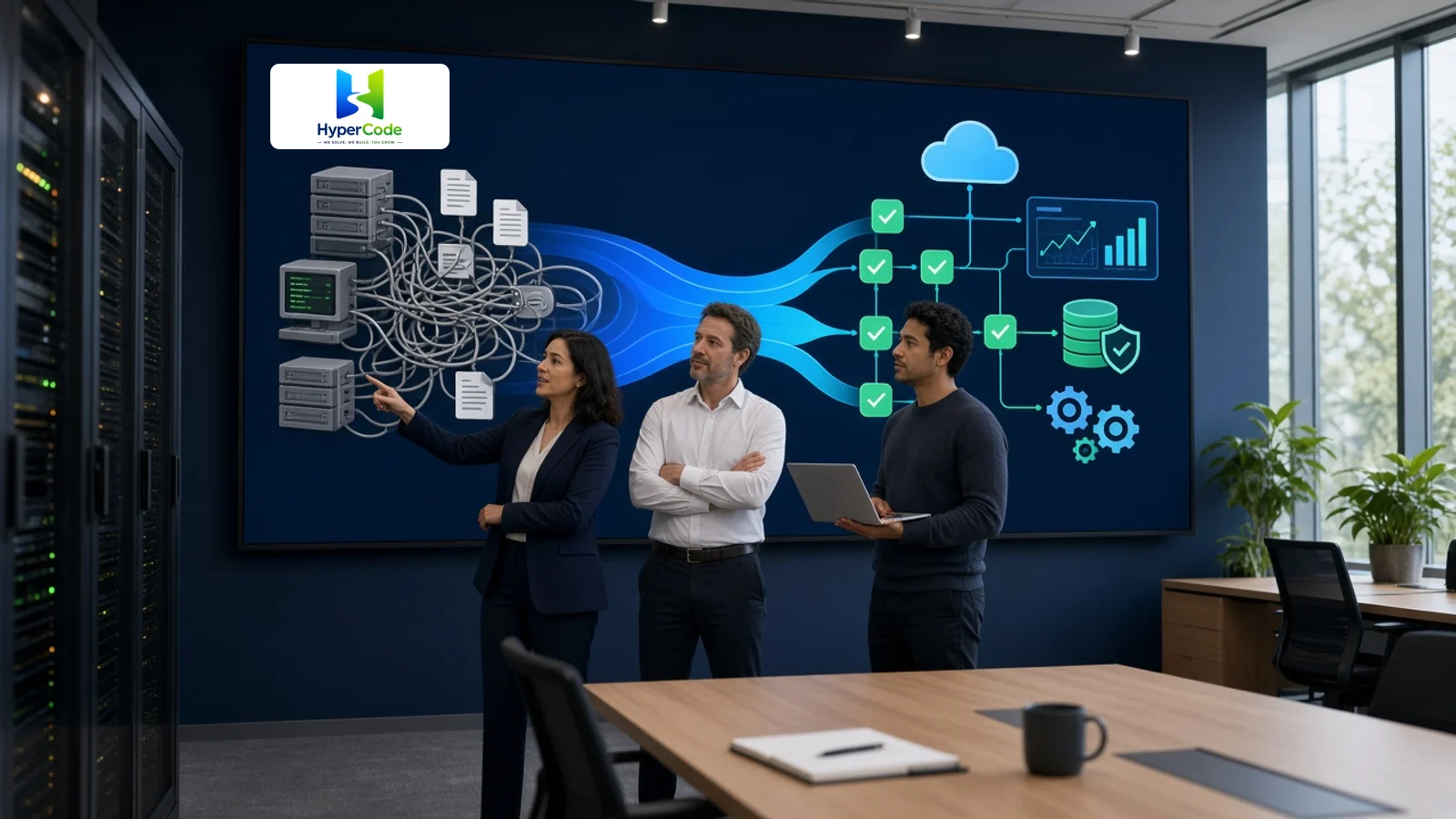
The strongest custom software development firm will spend time understanding the business before discussing frameworks, programming languages, cloud providers, or user interface features. That distinction is critical because software is ultimately an engineered response to an operational business problem.
Before issuing requests for proposals or comparing software development partners, leadership teams must define the problem in clear business terms:
When discussions center prematurely on technology stacks—whether microservices, modern JavaScript frameworks, or container orchestration—before operating friction is mapped, providers often deliver a feature-first build rather than an outcome-driven solution.
Visual 1 • Architectural Discovery Sequence
Identify the root operational friction, cost driver, or capacity bottleneck constraining business execution.
Map real stakeholders, daily decisions, operational handoffs, and friction points across internal and customer workflows.
Audit existing ERP, CRM, databases, and third-party cloud services that must remain reliable components of the environment.
Establish throughput, regulatory (HIPAA, SOC 2, GDPR), encryption, identity, and concurrency requirements upfront.
Define specifications, interface needs, and automated triggers derived directly from verified business constraints.
Select frameworks, database engines, and cloud architecture specifically engineered to deliver long-term business performance.
Business fit first. Technology follows.
A dependable technology partner does not merely document a feature wish list. During initial discovery, they actively uncover:
Engineering Accountability
A custom software development firm may possess an impressive global client roster, high-profile logos on its website, and an articulate executive sales group. However, the relevant question for your investment is: who will actually be responsible for engineering and delivering your software on a daily basis?
Before signing a master services agreement, evaluate the specific personnel assigned to discovery, systems architecture, core software engineering, quality engineering, project leadership, and ongoing production operations.
| Look For | Why It Matters | A Useful Question to Ask |
|---|---|---|
| Senior Technical Ownership | Complex architectural decisions require seasoned engineering judgment, battle-tested patterns, and risk foresight. | “Who specifically owns architecture decisions, and what production systems have they built?” |
| Business-Facing Communication | Technical delivery must remain continuously aligned with business outcomes and strategic priorities. | “Who translates our operational business requirements into engineering tickets and architectural constraints?” |
| Relevant Delivery Experience | Prior delivery must resemble the structural complexity of your operational problem, not merely an arbitrary industry label. | “Which comparable production system can the assigned delivery team explain in architectural depth?” |
| Continuity After Launch | Enterprise software requires structured maintenance, observability, monitoring, and iterative enhancements. | “Who supports the system in production when real users, real loads, and real edge cases emerge?” |
Visual 2 • Role Ownership Assessment
Defines system topology, data modeling, API boundaries, security baselines, and infrastructure patterns.
Who owns architecture decisions?Translates operational workflows, compliance rules, and strategic KPIs into engineering backlogs and milestones.
Who translates business requirements?Build maintainable, modular, well-tested code following consistent architectural conventions and continuous integration.
What is their production experience?Performs automated integration testing, regression checks, security audits, and user scenario validation.
How is quality verified continuously?Maintains timeline transparency, sprint velocity, dependency tracking, budget health, and risk mitigation.
How are trade-offs made visible?Monitors uptime, error tracking, infrastructure health, security patches, and post-launch feature releases.
Who supports the system in production?Demand named technical ownership across all disciplines before executing long-term agreements.
Rigorous Evaluation Framework
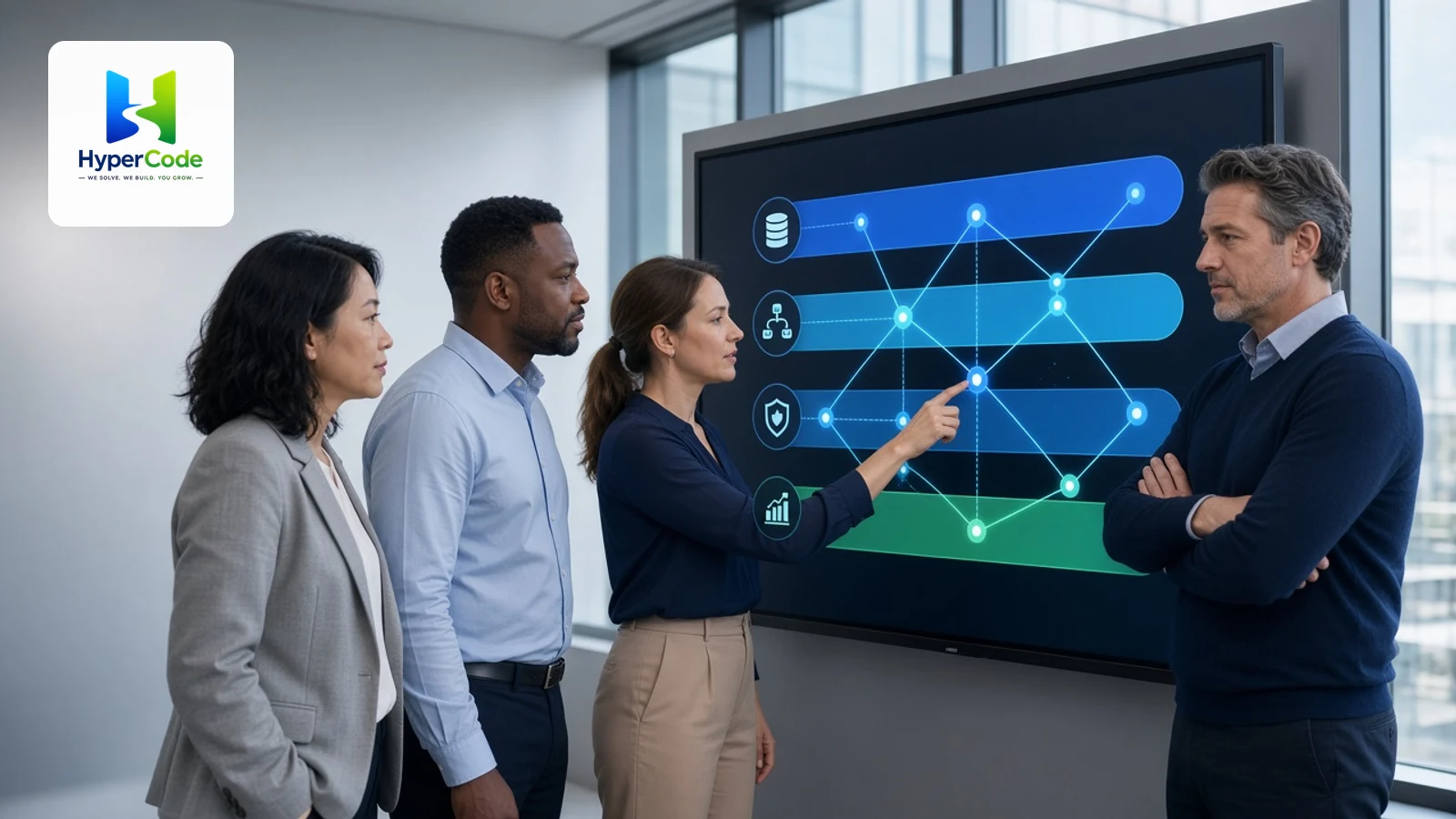
A vendor shortlist becomes significantly more actionable when every prospective development firm is assessed against the exact same rigorous evaluation criteria. Commercial terms and hourly rates can be reviewed later; first establish whether the provider has the technical competence, process maturity, and operational responsibility your project requires.
Visual 3 • The Partner Test
Connects software engineering decisions directly to business workflows, operational cost, revenue velocity, user satisfaction, and long-term operating objectives.
Evidence: Explains business impact and ROI metrics before pitching code.Engineers robust systems accounting for multi-tier integration, database scalability, data integrity, security boundaries, and modular maintainability.
Evidence: Provides detailed architecture diagrams and trade-off rationales.Demonstrates engineering best practices: code reviews, automated CI/CD pipelines, containerization, clear separation of concerns, and clean documentation.
Evidence: Demonstrates production-grade automated deployment pipelines.Integrates confidently with existing enterprise systems: REST/GraphQL APIs, ERP and CRM platforms, cloud storage, authentication providers, and legacy mainframes.
Evidence: Proven experience in bidirectional data sync and error recovery.Maintains continuous visibility into sprint velocity, architectural choices, emerging risks, scope changes, and budget burn throughout delivery.
Evidence: Structured sprint demos, live repositories, and visible backlog tracking.Treats unit and integration testing, role-based access control, encryption in transit and at rest, and full observability as core engineering deliverables.
Evidence: Security-first code reviews and automated vulnerability scanning.Delivers full source-code ownership, comprehensive architectural documentation, developer onboarding guides, and structured SLAs for ongoing support.
Evidence: Zero intellectual property lock-in and transparent transition protocols.TECHNICAL CONFIDENCE SHOULD COME FROM EVIDENCE — NOT VOCABULARY.
Proposal Due Diligence
Too many vendor proposals are structured as high-level marketing brochures that outline a feature list, attach a generic timeline, and state a fixed price or hourly billing model. However, when software must support core business operations, a proposal that answers only “what will you build?” is dangerously incomplete.
A rigorous engineering proposal must clearly answer critical structural questions:
When these fundamental operational questions are glossed over or relegated to verbal assurances, the apparent simplicity of a proposal is often concealing significant downstream delivery and financial risk.
Vetting & Verification
The partner selection process should feel less like a sales pitch and more like a structured technical and operational audit. Use the diligence phase to test how the development firm thinks, investigates, and responds under pressure, not merely how well its sales team presents slides.
Risk Detection
When evaluating multiple software development companies, certain communication patterns and structural promises indicate substantial downstream risk. Recognizing these indicators early protects your timeline, budget, and operational stability.
Visual 4 • Risk Assessment
The provider rushes into discussing UI mockups, animations, and feature lists before understanding your core business problem, workflows, and technical constraints.
A complex multi-system enterprise project receives a rigid delivery promise or fixed launch date prior to thorough architectural discovery or technical vetting.
The firm displays beautiful marketing screenshots but engineers cannot explain database concurrency, API latency, security models, or architectural trade-offs.
The commercial pitch centers almost exclusively on rock-bottom hourly rates rather than total cost of ownership, risk mitigation, and long-term business value.
Support, security monitoring, infrastructure patching, and ongoing feature enhancements are treated as vague afterthoughts left undefined in the proposal.
“Who gave us the lowest quote?”
“Which firm gives us the clearest path from business problem to reliable production system?”
Engineering Philosophy
HyperCode approaches custom software development as both an engineering discipline and a strategic business engagement—never as an isolated coding assignment. Headquartered in Schaumburg, Illinois, HyperCode partners with growing businesses and mid-market enterprises across the United States to turn complex operational friction into scalable digital capability.
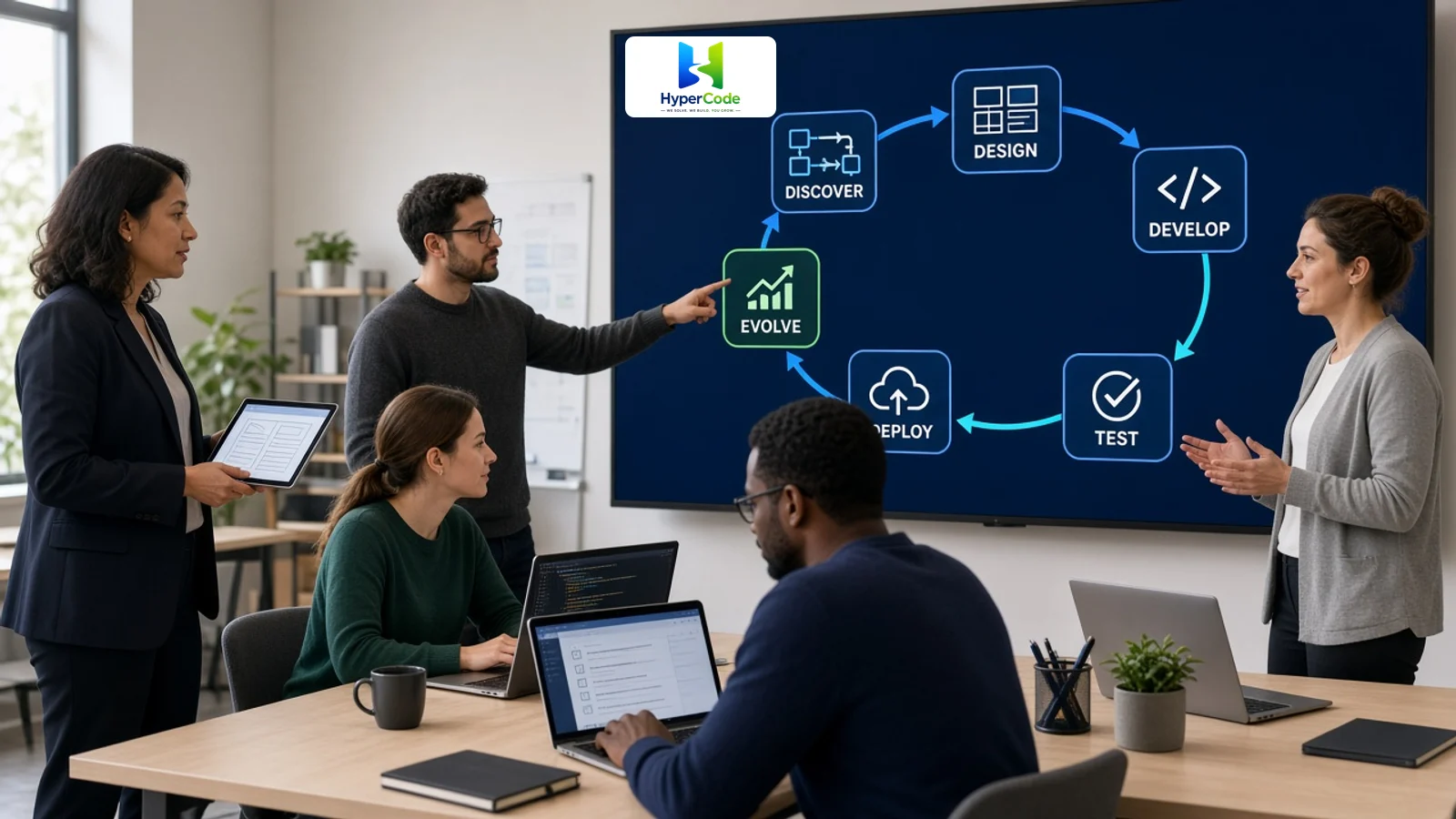
HyperCode’s structured delivery model follows a disciplined, end-to-end execution sequence:
For organizations evaluating a custom software development firm, this distinction is transformative. The right technology partner looks holistically across your operating workflows, data stores, legacy systems, and commercial priorities to determine exactly what should be custom-built, what should be modernly integrated, and what should be strategically improved.
The Long-Term View
Selecting a custom software development partner should never end when the initial scope of work is signed. The true test of software engineering begins when the production system confronts real human users, real transaction volumes, and real business pressure.
Interactive Selection Roadmap
A continuous evaluation journey from initial problem scoping to resilient, scalable technology partnership.
With an authentic engineering partner, the conversation rapidly evolves beyond transactional inquiries like “Can you build this screen?” into questions that govern sustainable competitive advantage:
A Partnership Built for What Comes Next
Understand operational workflows, users, data structures, and organizational constraints before choosing software technologies.
Build around high-impact business capabilities while enforcing rigorous security, modular architecture, and code maintainability.
Ensure new applications communicate reliably with the databases, APIs, cloud services, and legacy platforms already running the business.
Monitor production metrics, maintain infrastructure dependability, and iterate software capabilities as business opportunities expand.
DON’T JUST CHOOSE A FIRM TO BUILD THE SOFTWARE.
CHOOSE A PARTNER TO BUILD WHAT COMES NEXT.
HyperCode
Technology Consulting
HyperCode is a Schaumburg, Illinois-based technology consulting and engineering company founded in 2014.
HyperCode helps organizations move from business complexity to dependable digital capability through discovery, architecture, engineering, integration, automation, and long-term technology support.

Learn how custom business software development helps organizations improve efficiency, integrate systems, automate workflows, and generate long-term ROI through scalable digital solutions.

Learn why custom software development solutions help enterprises align technology with unique workflows, integrations, data, customer experiences, and long-term business growth.

Learn how organizations can modernize core enterprise systems while preserving valuable business logic, data, integrations, and operational knowledge.

Learn how custom software moves from business idea to dependable digital product through planning, design, engineering, testing, deployment, and continuous improvement.

A practical guide to how enterprise AI companies design intelligent systems through strategy, data, architecture, automation, and scalable implementation.

A practical framework for turning automation investment into measurable business value.

A practical guide to where enterprise AI software creates measurable business value.

A business-led guide to moving from AI opportunity to practical, secure and scalable enterprise execution.

A practical guide to choosing an enterprise AI platform that can scale with your business across data, security, integration, governance, flexibility, performance, and cost.

How purpose-built enterprise software helps organizations connect systems, automate workflows, modernize operations and create a scalable foundation for growth.

How organizations can use generative AI to improve operations, strengthen decision-making, accelerate innovation, and build secure, scalable AI capabilities.

A practical enterprise guide to healthcare AI automation, secure architecture, governance, clinical support, predictive analytics, and responsible implementation.